If you run a gym, a nutrition practice or a wellness program, you already collect more data than you think. Sleep scores from wearables, weekly weigh-ins, meal logs, class attendance, membership renewals, survey answers after a program ends. Most of it sits in spreadsheets and app exports, and most of it never answers the question you actually care about: which clients are improving, and why?
That gap is where a new kind of role has grown up around health and fitness businesses. Someone has to pull the exports together, clean them, put them somewhere queryable and report on them. If you are that person, or want to be, the Google Cloud Certified Associate Data Practitioner credential is a sensible target. This article looks at how to prepare for it using the Google Cloud Certified Associate Data Practitioner practice tests from Be Ready Education, what they offer, and where they stop.
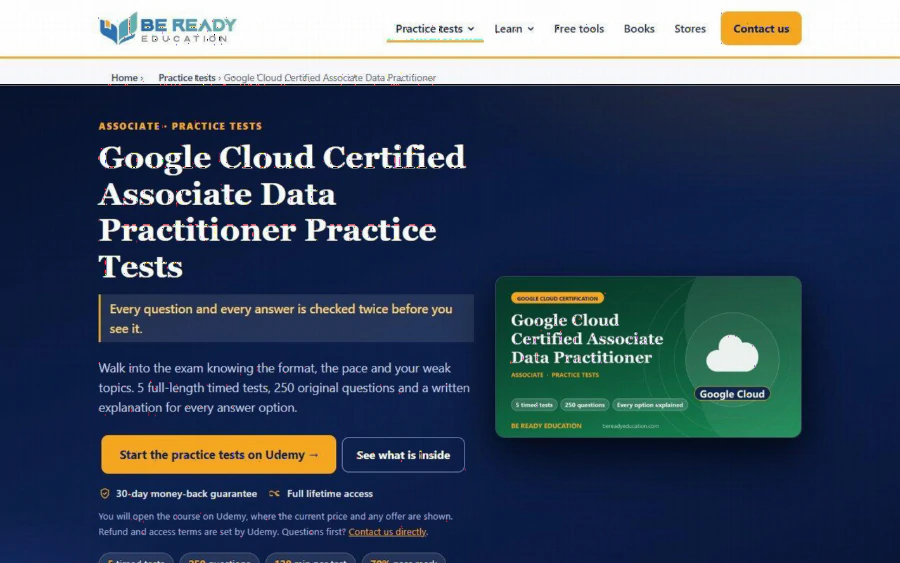
The Be Ready Education page for the Google Cloud Certified Associate Data Practitioner practice tests, showing five timed tests and 250 original questions
A realistic scenario: the wellness coach with eight spreadsheets
Picture a coach named Dana who runs a small studio with three trainers. Each trainer keeps a separate spreadsheet of client check-ins. Billing lives in another tool, and class bookings in a third. When Dana wants to know whether clients who attend twice a week renew more often than those who attend once, she spends an afternoon copying columns around.
A data practitioner on Google Cloud would approach this differently. The raw exports land in cloud storage. A pipeline loads them into a warehouse, a few queries join check-ins to bookings to billing, and a dashboard refreshes without anyone copying anything. The associate level of the Google Cloud certification is aimed at exactly this kind of everyday work. The exam page on Be Ready Education describes it as covering everyday data tasks on Google Cloud: ingesting, analyzing and managing data. It does not list formal domains or weightings, which is worth knowing before you plan your study time, and the page tells you to confirm details on the official exam guide before booking.
The same page says the official exam runs two hours, uses multiple choice questions, and can be taken online with a proctor or at a testing center. Those details come from the provider and can change, so treat them as a starting point, not a promise.
What the practice tests actually contain
According to the product page, the course on Udemy includes five full-length timed tests, 250 original questions in total, so 50 questions per test. Each test gives you 120 minutes, which works out to roughly 144 seconds per question. The listed pass mark for the practice tests is 70 percent.
Two features matter more than the headline numbers.
First, every answer option has a written explanation. The page says each question comes with a rationale for the correct answer and for every incorrect option. For a data role this is valuable, because the hard part is rarely knowing what a service is. It is knowing why you would pick one tool over another for a given job. A wrong option explained well teaches you the boundary between two similar services.
Second, the questions are original. The page states they are not real exam content, and the course makes no claim to reproduce anything from the actual test. That is the right approach for a credential you want to be able to defend in an interview.
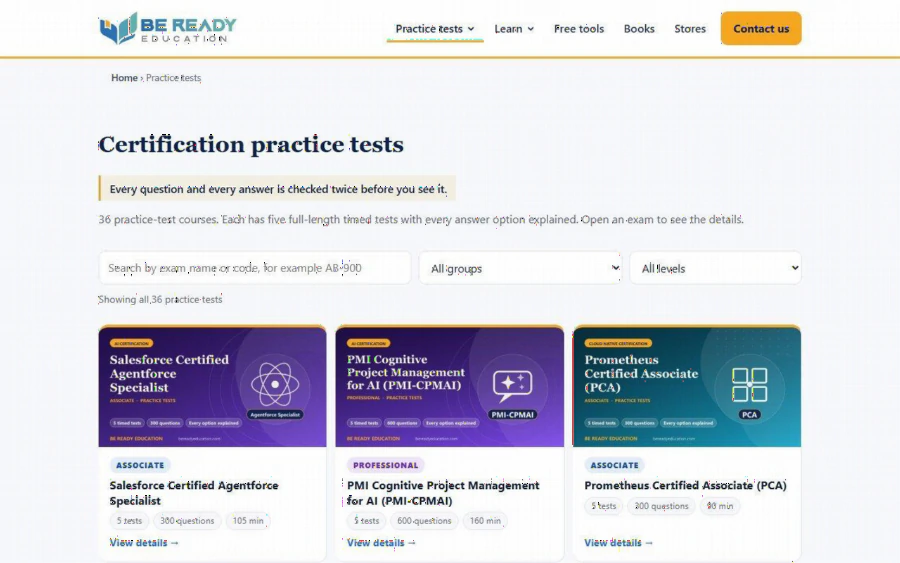
The Be Ready Education overview of all practice tests, showing 36 courses with five timed tests each
How to use the tests if you work in health and fitness
The practice format suits people who are learning while holding a day job, which describes most wellness professionals moving into data work. A few ways to get value from it:
Start with a cold test. Take the first test before you study anything. The goal is not a good score. The goal is a map of your weak spots. If you come from spreadsheets, you may be comfortable with filtering and summarizing but shaky on how cloud services divide the work of storing, transforming and analyzing data.
Read every explanation, including for questions you got right. Because the course explains each option, a correct guess can still teach you something. If you picked the right answer for the wrong reason, the written rationale will show it.
Tie each topic back to your own data. When a question compares a warehouse to other storage options, think of Dana's studio: where would the weekly check-in exports belong, and why? This turns abstract service comparisons into something you will remember. The exam page itself includes a free sample question on BigQuery versus other Google Cloud services, with an explanation for each option, which is a good way to judge the style before you commit.
Use the readiness target. The page suggests aiming for 80 percent or more on two tests in a row before booking the real attempt. That is a more conservative bar than the 70 percent pass mark, and it is a sensible buffer for an unfamiliar exam format.
Add the free study aids. The page lists a free study plan in two-week and four-week versions, plus a free exam timer, a pass score calculator and a practice score tracker. If you are juggling client sessions, a fixed plan beats open-ended good intentions.
Strengths and limits, stated plainly
What the product does well is straightforward. It gives you a lot of timed practice at a stable format, with explanations that treat wrong answers as teaching material. The page also notes a 30-day money-back guarantee and lifetime access, with refund and access terms set by Udemy. The page does not state a price and sends buyers to Udemy for the current figure, so check it there rather than relying on any number you read elsewhere.
There are limits you should weigh honestly.
- It is practice, not instruction. The tests show you what you do not know. They do not replace hands-on time in the Google Cloud console. If you have never loaded a file into a warehouse, do that once on a free tier account alongside the tests.
- It is multiple choice only. Practice tests train recognition and judgment under time pressure. They do not train typing a query from memory.
- No pass guarantee. Nothing here promises you will pass. The pass score calculator and score tracker help you gauge readiness, but the exam is set and run by Google Cloud, and the format and rules can change.
- Domain weightings are not published on the page. If you want to prioritize by topic, read the official exam guide first and map it to the practice results yourself.
Who should use it, and who should not
This course fits people who already understand the basics of data, such as tables, joins and charts, and want structured exam practice for the associate level. The page positions the credential for roles like data analyst and junior data engineer, which lines up well with a wellness business owner who has become the de facto analyst, or a staff member trusted to build the reports.
It is probably not the right first step if you have never worked with structured data at all. In that case, spend a few weeks on a beginner data course or a spreadsheet to database tutorial before paying for exam practice, because the explanations assume you can follow the vocabulary.
It is also not for anyone looking for a shortcut. The product itself is clear that its questions are original and that your own preparation does the work.
If you are weighing other credentials, Be Ready Education lists 36 practice-test courses, each with five timed tests, across AI, cloud, security and agile. The site also points to CompTIA Data+ as the natural next certification after this one, which is useful if you want a vendor-neutral credential to follow a Google Cloud one.
A simple way to begin
1. Open the Be Ready Education exam page and read the sample question and the exam-day checklist.
2. Check the official exam guide from Google Cloud, and note the format and the current rules.
3. Pick the two-week or four-week study plan, depending on how many evenings you can protect around client hours.
4. Take test one cold, then spend a full session reading every explanation.
5. Repeat with tests two to five, tracking your score, and book the exam only after two results at 80 percent or above.
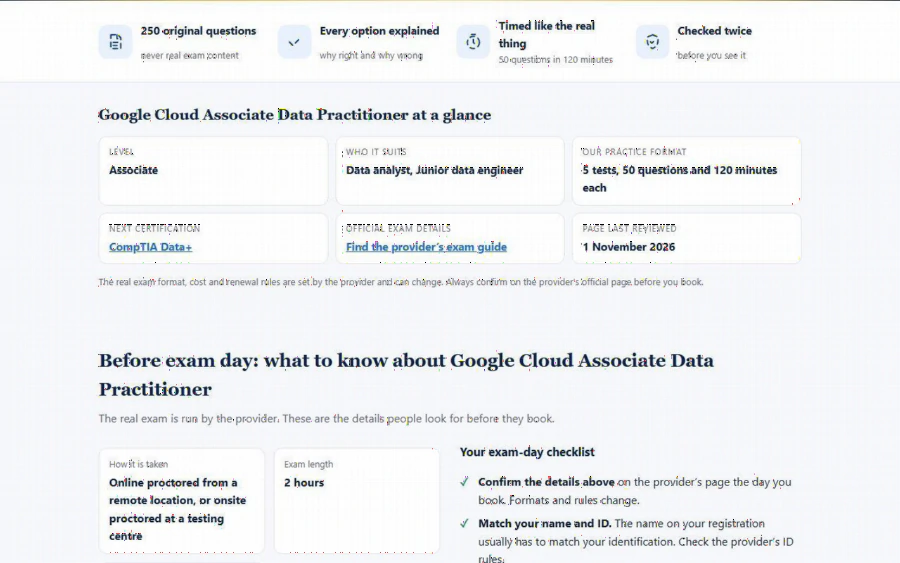
The exam page overview showing the practice format of five tests, 50 questions and 120 minutes each, and the exam-day checklist
For anyone in health and fitness who has started to feel that the real value of the business is hiding in its numbers, this is a practical, low-risk way to build the skills to get it out. The tests will not do the learning for you, but they will tell you quickly and clearly where to spend your next study hour. You can browse the full list of courses on the full catalog of certification courses if you want to compare options before you decide.