Anyone who has trained for a race knows the pattern. You do not run the full distance on day one, you build a base, add load in steps, and taper before the big day. Studying for a professional certification works the same way, and it is kinder to your sleep, your stress levels, and your wellbeing than a last minute cram. This guide lays out a four week plan for the NVIDIA-Certified Professional: Agentic AI exam, known as NCP-AAI, with a rhythm you can actually keep.

A smiling professional in a blazer stands in front of colleagues and screens showing workflow diagrams, next to a certificate with a gold seal
What the exam covers, according to NVIDIA
Before planning anything, read what the certifying body says. NVIDIA's certification page describes the exam as a 120 minute, online, remotely proctored test with 60 to 70 questions, listed at $200. A pass is valid for two years, and recertification is done by retaking the exam. The page recommends one to two years of AI and machine learning experience, including hands-on work with production level agentic AI projects. It does not state a passing score, so do not trust any site that quotes one without a source.
The same page lists topic weights. Agent Architecture and Design and Agent Development each carry 15 percent. Evaluation and Tuning and Deployment and Scaling each carry 13 percent. Cognition, Planning, and Memory and Knowledge Integration and Data Handling carry 10 percent each. NVIDIA Platform Implementation is 7 percent, and Run, Monitor, and Maintain, Safety, Ethics, and Compliance, and Human-AI Interaction and Oversight are 5 percent each. Fees, formats, and weights can change, so confirm them on NVIDIA's site before you book.
Those weights are the backbone of your plan. They tell you where an hour of study pays back the most.
Week one: build the base
Spend the first week on the two heaviest topics, architecture and development. Aim for five or six sessions of 45 to 60 minutes rather than two marathon evenings. Short sessions are easier to protect, and your memory consolidates better when you sleep between them.
Focus on the vocabulary and the building blocks. What is an agent loop, how does a planner differ from an executor, when does a single agent make sense and when does a multi agent design earn its complexity? Sketch these ideas by hand. If you cannot draw how a request flows through an agent, tools, and memory, you do not know it yet.
End the week with a short self check, not a full exam. The goal is to find gaps early, while there is still time to fix them without panic.
Week two: widen the map
Week two covers evaluation, deployment, planning, memory, and data integration. This is the broadest stretch of the plan, and it is where candidates with only prototype experience tend to feel the ground shift. Production questions reward judgment: how do you measure whether an agent is actually improving, what breaks when traffic scales, what do you log so that a failure can be diagnosed later?
Keep one habit from week one. After each session, write down three things you could not explain without looking. Those notes become your personal revision sheet, and they are worth far more than highlighted pages.
This is also a good moment to protect your body. Sitting through long study blocks is hard on the back and eyes. Stand up every 50 minutes, take a ten minute walk after a heavy session, and drink water. A tired brain makes confident mistakes, which is exactly what scenario questions punish.
Week three: practice under exam conditions
By week three you should shift from reading to doing. Practice tests are most useful here, because they train the skill the real exam measures: choosing the best answer under time pressure, when several options look reasonable.
One option is the NVIDIA-Certified Professional: Agentic AI practice tests from Be Ready Education on Udemy. It is an independent set of practice material, with five timed tests of 65 questions each, 325 questions in total, and every question comes with an explanation. It is not affiliated with NVIDIA and does not replace NVIDIA's own documentation or real project experience. Think of it as a way to rehearse, not a shortcut.
Here is a routine that works well. Take one full test in a single sitting, with a timer, no notes, and no phone. Then spend at least as long reviewing as you spent testing. For every miss, read the explanation, name the concept behind it, and go back to the source material. Pay equal attention to the questions you got right by guessing. Those are the quiet risks.
Take two or three of the five tests this week, spaced across the days, with a rest day in between. Do not stack them back to back. Fatigue lowers your scores and teaches you nothing useful.
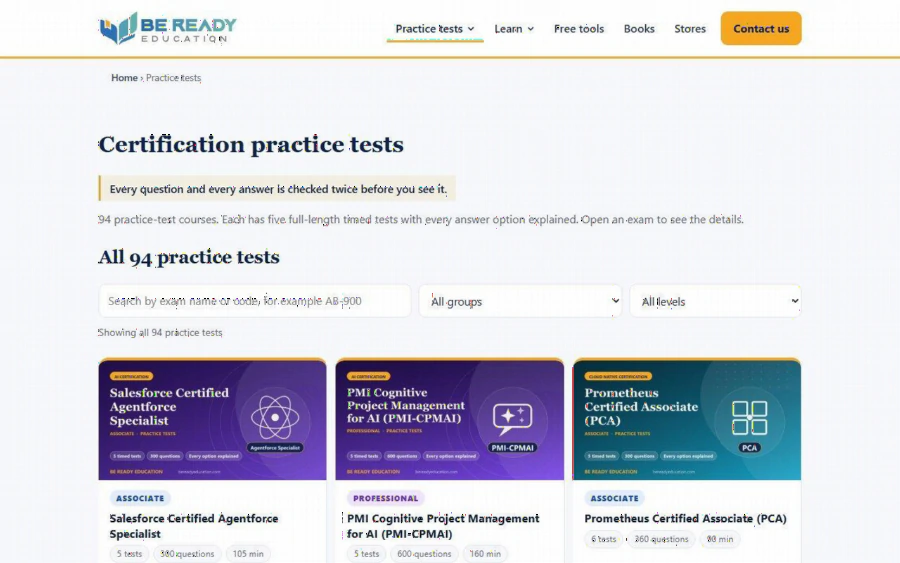
A certification practice tests catalogue page showing exam cards with the number of tests, questions, and minutes for each exam
Week four: sharpen and taper
The final week is about consolidation. Take your remaining practice tests early in the week, then stop adding new material. Go back through your revision sheet from the earlier weeks and rank your weak spots by topic weight. A gap in a 15 percent topic deserves more time than a gap in a 5 percent one.
Safety, ethics, and oversight can look small on the weight chart, but they are the easiest points to collect with a short review, because the concepts are compact and the questions tend to be about sound judgment. Give them one calm session rather than ignoring them.
In the last two days, taper. Light review in the morning, a walk, a proper dinner, and a real night of sleep. Check your testing setup, since the exam is remotely proctored: stable connection, a clear desk, working camera, and an ID ready. Few things drain focus like a technical problem in the first five minutes.
On exam day, eat something with protein, log in early, and read each question twice. If a question stalls you, mark it and move on. With 60 to 70 questions in 120 minutes, you have roughly a minute and a half per question, which is enough if you do not let one item eat five.
Keeping the plan honest
A plan is only useful if you adjust it. If week two shows you are weak on deployment, borrow time from a topic you already handle well. If life interrupts, shorten sessions instead of skipping them, because 20 focused minutes beat a guilty zero.
Be realistic about what practice tests can do. They sharpen recall, expose gaps, and build timing, but they cannot give you the hands-on instincts that come from building and running agents. If your background is light on production work, spend some of your hours building a small agent, breaking it, and fixing it. That experience is what the exam, and a real job, will test.
If you want to compare other options before committing, Be Ready Education keeps a other exam prep sets on their exams page you can browse by topic and level.
The takeaway
Four weeks is enough for a focused candidate with some real agent experience. Build the base in week one, widen it in week two, practice under pressure in week three, and taper in week four. Weight your hours by the official topic percentages, rest as seriously as you study, and treat every wrong answer as information. A steady plan will carry you further than a heroic final weekend, and you will walk into the exam calm instead of exhausted.